

Diseases and pests identification
We are delighted to introduce a new feature in the Pl@ntNet application: the ability to identify plant diseases and pests from images. This first version aims to help users detect visible symptoms caused by common diseases or pests on a limited set of plant species.
By uploading photos showing signs of disease or infestation (leaf spots, discoloration, deformations, or the presence of insects), users can receive preliminary suggestions about potential problems affecting the plant. Up to four photos can be sent; do not hesitate to take several shots of the signs of disease to improve the results.
While it is set to grow and improve over time, it already constitutes a solid base to support users in observing and understanding plant health. New diseases, pathogens, and plant species will be added progressively.
Disease identification results should be considered as informative advice, and not as a professional diagnosis, and are not intended to provide information on treatments (legally, this often depends on the governments of each country).
How can I access this new feature?
Section titled “How can I access this new feature?”Disease and pest identification is available to everyone:
-
On the website: https://identify.plantnet.org/diseases-and-pests
-
On the mobile application (v3.26 minimum): by choosing the “Diseases and pests” flora in the “Specific Floras” sub-menu.
The contribution of disease observations is currently very limited. If you are a professional specialized in certain diseases and wish to improve their identification performance, please fill out the following form: https://forms.gle/BYH7WC9d8eJEm3dk9. Please provide detailed information about your skills and profession so that we can respond to your request as quickly as possible, generally within 3 working days.
To go further
Section titled “To go further”Help us cover more species: share your datasets!
Section titled “Help us cover more species: share your datasets!”If you are an expert Pl@ntNet user and have access to high-quality images showing plant diseases or pests (with reliable annotations), we would love to receive your help!
The contribution of these datasets can significantly improve the accuracy and coverage of our new disease identification feature. If you wish to share data or collaborate, please contact us (mentioning it in the comment field of the form) - we are excited to co-build this feature with the community.
Which species are already covered?
Section titled “Which species are already covered?”We are continually importing new data to cover a larger number of species, so be sure to visit this page for an up-to-date overview of all currently supported species: https://identify.plantnet.org/diseases/species/tags/phytopatho
As an example, as of March 2026, we already covered the following species:
-
Allium ampeloprasum - Wild Leek
-
Allium cepa - Onion
-
Allium sativum - Garlic
-
Ananas comosus - Pineapple
-
Asparagus officinalis - Asparagus
-
Avena sativa - Cultivated Oat
-
Beta vulgaris - Common Beet
-
Brassica napus - Rapeseed
-
Brassica oleracea - Romanesco Broccoli
-
Capsicum annuum - Bell Pepper
-
Carica papaya - Papaya
-
Castanea sativa - Sweet Chestnut
-
Cicer arietinum - Chickpea
-
Citrullus lanatus - Watermelon
-
Citrus × aurantiifolia - Key Lime
-
Citrus × aurantium - Bitter Orange
-
Citrus × latifolia - Persian Lime
-
Citrus × limon - Lemon
-
Citrus hystrix - Kaffir Lime
-
Citrus maxima - Pomelo
-
Citrus medica - Buddha’s Hand
-
Coffea arabica - Arabian Coffee
-
Corylus avellana - Hazelnut
-
Cucumis melo - Melon
-
Cucumis sativus - Cucumber
-
Cucurbita pepo - Field Pumpkin
-
Daucus carota - Wild Carrot
-
Foeniculum vulgare - Fennel
-
Glycine max - Soybean
-
Helianthus annuus - Sunflower
-
Hordeum vulgare - Common Barley
-
Humulus lupulus - Hop
-
Juglans regia - Common Walnut
-
Lactuca sativa - Lettuce
-
Lathyrus oleraceus - Garden Pea
-
Lens culinaris - Lentil
-
Mangifera indica - Mango
-
Medicago sativa - Alfalfa
-
Musa × paradisiaca - Plantain
-
Musa acuminata - Dessert Banana
-
Musa balbisiana - Wild Forest Banana
-
Nicotiana tabacum - Virginia Tobacco
-
Persea americana - Avocado
-
Phaseolus vulgaris - Common Bean
-
Pisum sativum - Garden Pea
-
Prunus armeniaca - Apricot
-
Prunus domestica - Plum
-
Prunus dulcis - Almond
-
Prunus persica - Peach
-
Pyrus communis - Pear
-
Raphanus raphanistrum - Wild Radish
-
Ribes nigrum - Blackcurrant
-
Rubus idaeus - Raspberry
-
Solanum lycopersicum - Tomato
-
Solanum melongena - Eggplant
-
Solanum tuberosum - Potato
-
Sorghum bicolor - Common Sorghum
-
Spinacia oleracea - Spinach
-
Triticum aestivum - Common Wheat
-
Vanilla planifolia - Vanilla
-
Vicia faba - Broad Bean
-
Vitis vinifera - Grapevine
-
Zea mays - Maize
Explore observations of plants with diseases
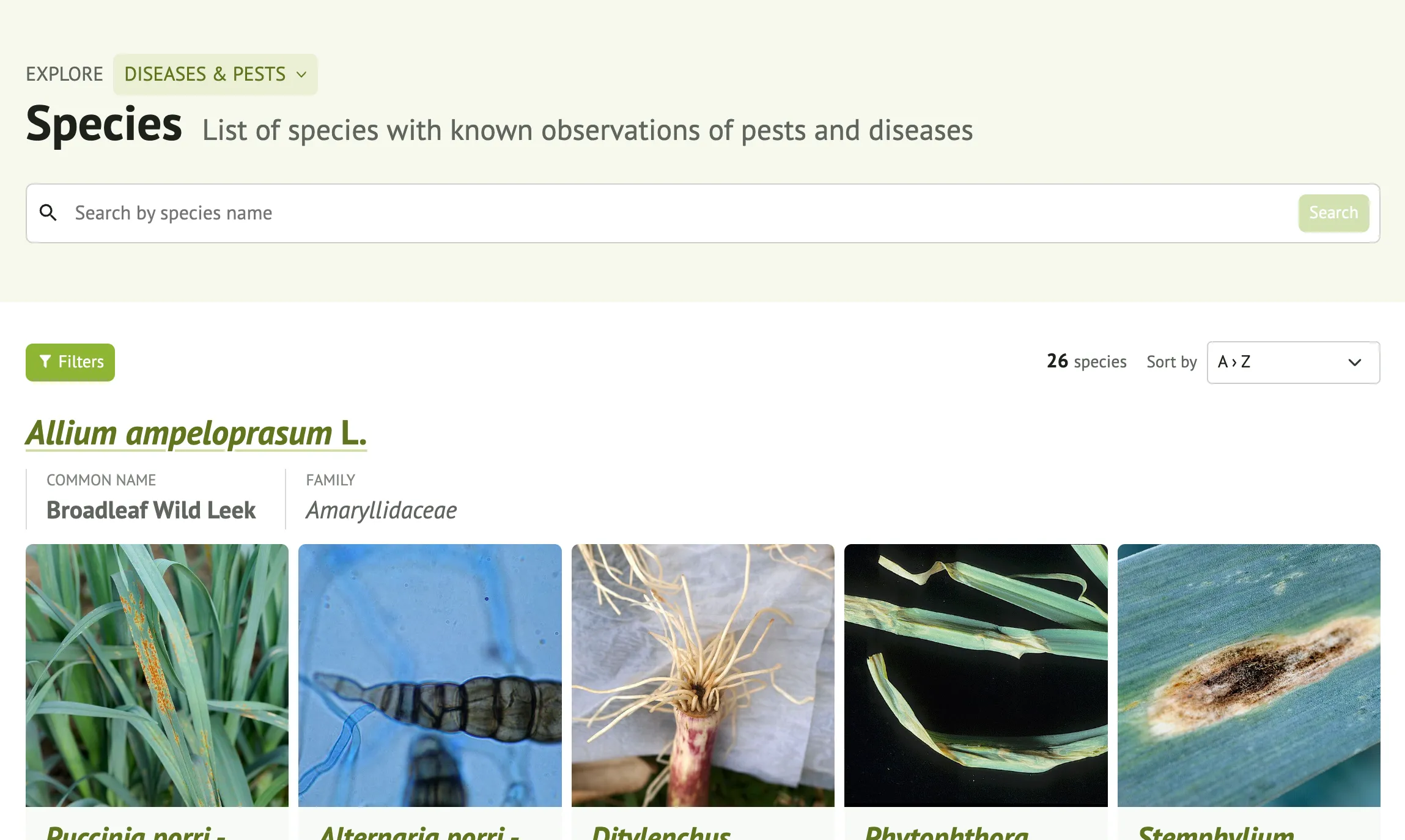
Section titled “Explore observations of plants with diseases”With this new feature, Pl@ntNet users will also be able to explore community observations of plants affected by various diseases and pests. These real-world examples, provided by other users and institutes, offer valuable insights into how different symptoms appear on specific species.
Whether you are looking to identify a problem or learn more about plant health, this growing collection of annotated images will help you recognize and compare visible signs of plant stress.
Identify plants affected by diseases or pests
Section titled “Identify plants affected by diseases or pests”Beyond searching for observations, this feature allows you to identify specific diseases and pests directly from your own images.
By uploading a photo that clearly shows symptoms - such as spots, wilting, discoloration, or the presence of insects - Pl@ntNet will analyze the image and suggest possible causes. These suggestions are based on visual similarities with verified cases in our database and are intended to help you quickly understand what may be affecting the plant.
Disease identification is available at the following address: identify.plantnet.org/diseases-and-pests and works almost in the same way as the classic Pl@ntNet identification you are used to. Pl@ntNet also suggests the various host species for the diseases in question.
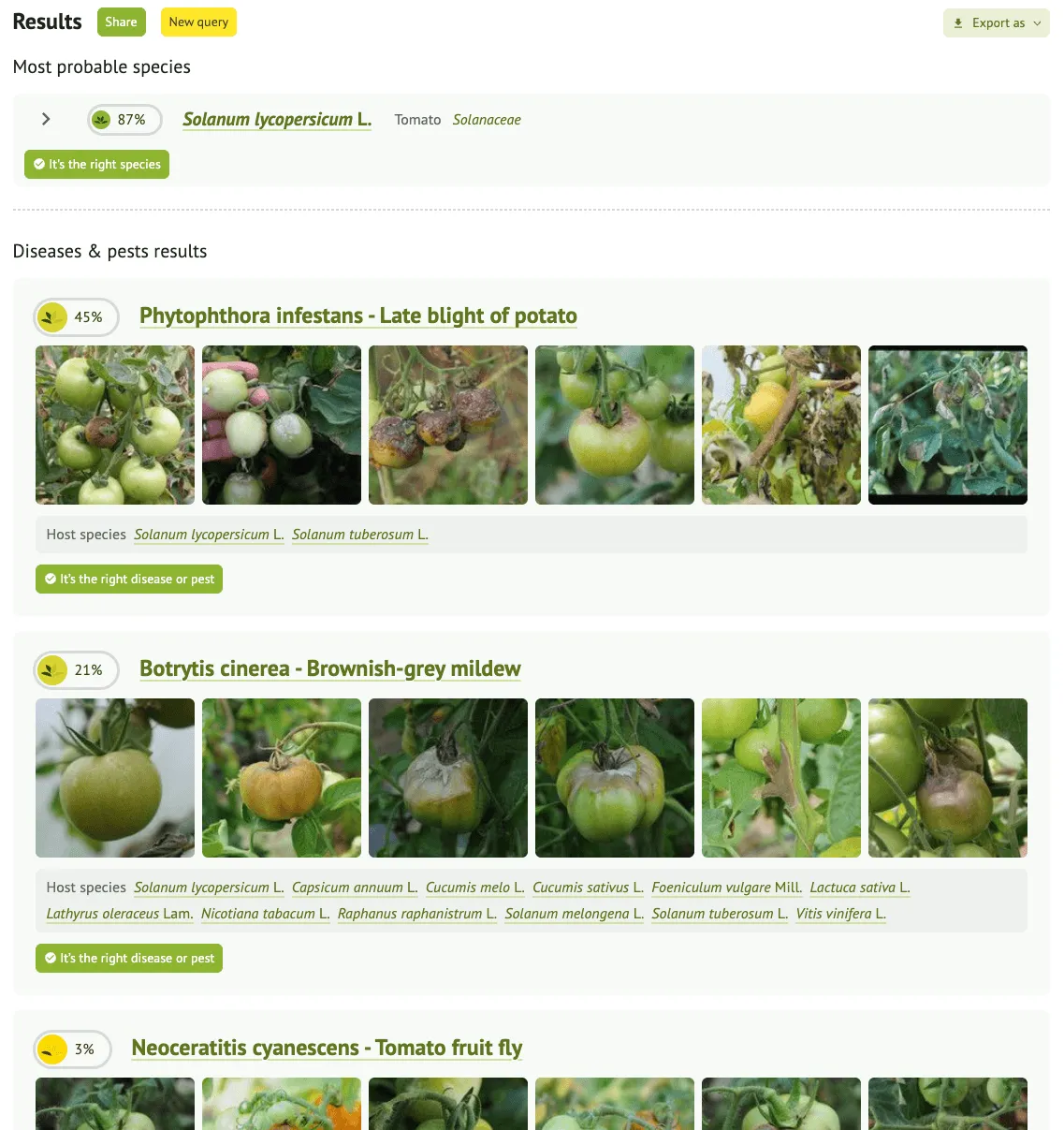
For now, disease identifications cannot be shared on the platform like regular plant observations to prevent potential determination errors from spreading in our datasets (unless your profession has led you to contact us, see above).
Annotate existing plant observations with diseases
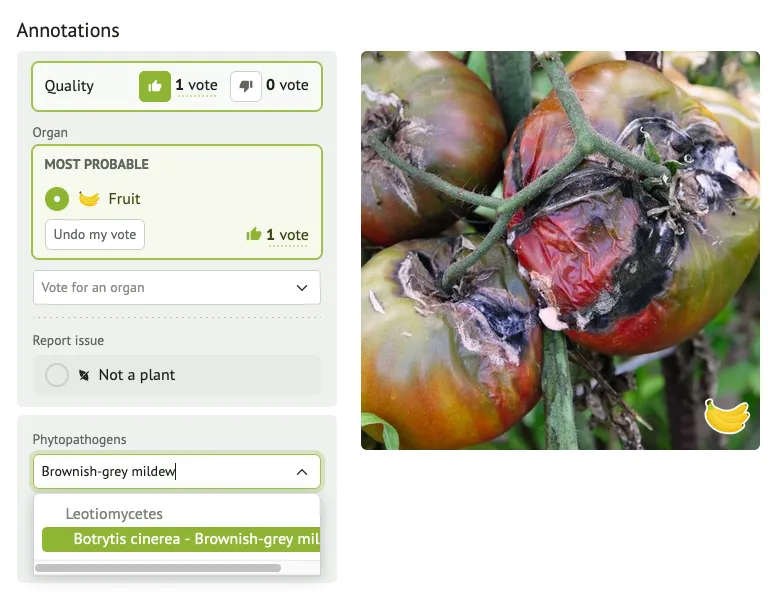
Section titled “Annotate existing plant observations with diseases”Once the disease or pest is selected, it annotates the plant observation with the disease or pest.
If you recognize symptoms on an image or if you know the specific problem affecting the plant, you can add or suggest annotations to enrich the database.
As mentioned previously and to improve identification performance, only a small number of users can contribute to these annotated observations. These contributions are essential for improving the accuracy of the identification feature and building a more comprehensive resource for the entire Pl@ntNet community.
Each image of an observation can receive a set of annotations. To annotate an image, select the “Phytopathogens” annotations in the Annotations section next to the image and search for a specific value. If the disease you identify on your image is not in the list and you have more than 10 images illustrating it, please contact us here.
Research effort behind this feature
Section titled “Research effort behind this feature”This new disease and pest identification feature is the result of ongoing research on phytosanitary diagnostics using computer vision and deep learning techniques. It builds on recent advances in image-based plant pathology and benefits from datasets created by experts to train and evaluate our models.
This collaboration between science and citizen observation is at the heart of Pl@ntNet’s mission: transforming collective intelligence into actionable tools for biodiversity and plant health monitoring.
We would like to especially thank the participation of EPPO, INRAE, Cirad, and IRD.